



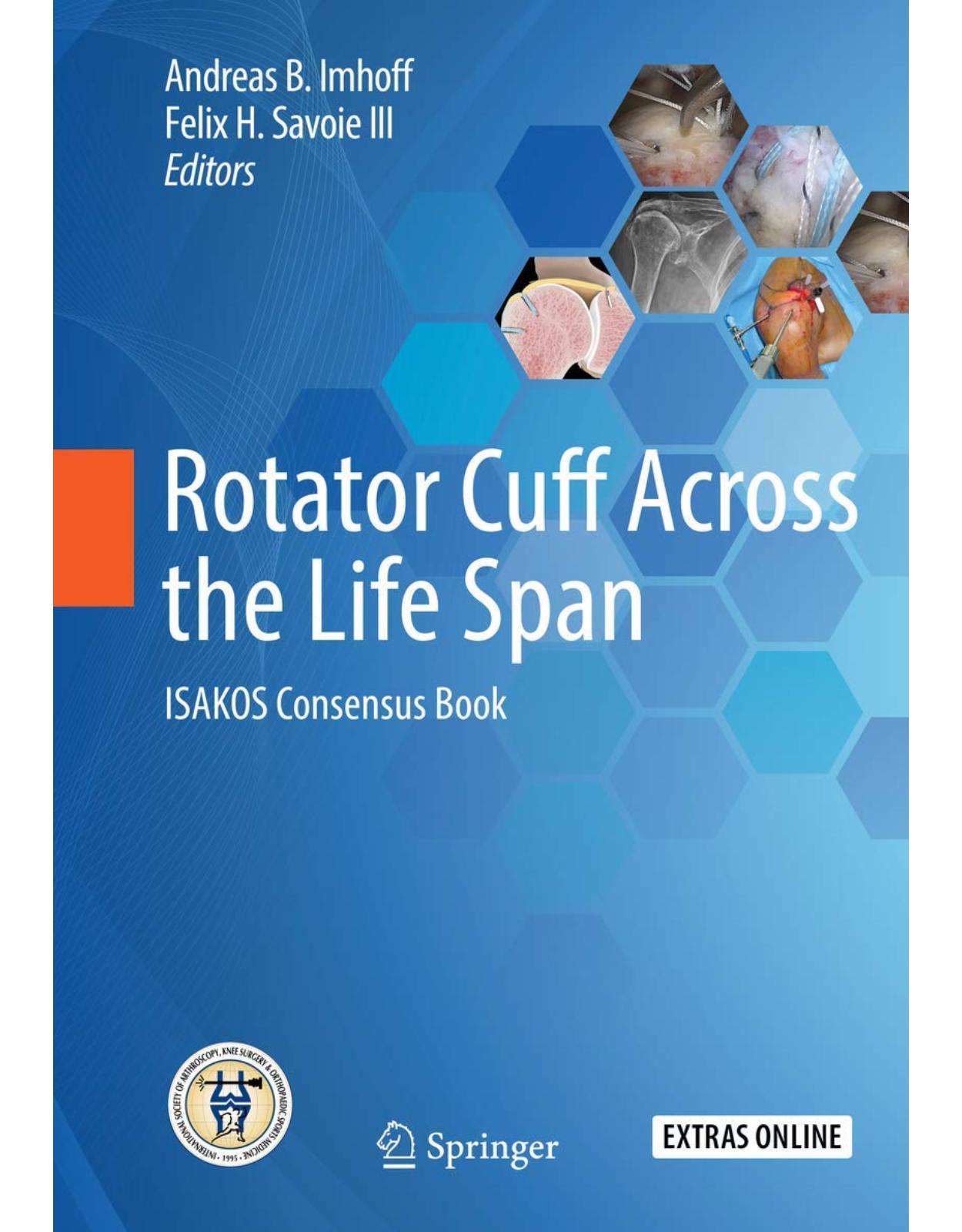
Rotator Cuff Across the Life Span
Livrare gratis la comenzi peste 500 RON. Pentru celelalte comenzi livrarea este 20 RON.
Disponibilitate: La comanda in aproximativ 4-6 saptamani
Editura: Springer
Limba: Engleza
Nr. pagini: 526
Coperta: Hardcover
Dimensiuni: 18.42 x 3.18 x 25.4 cm
An aparitie: 28-04-19
Description:
This book presents the consensus findings of the ISAKOS Shoulder Committee regarding the treatment options in patients suffering from shoulder pain and reduced function or dead arm syndrome as a consequence of rotator cuff injuries. The aim is twofold: to equip readers with a precise knowledge of the presenting characteristics of these injuries in different age groups and to describe in detail the initial management and surgical and non-surgical approaches, taking into account the age-specific features. Readers will find clear descriptions of all the latest arthroscopic techniques, which allow repair of even the largest tears. The indications for and performance of tendon transfer procedures, biceps tenotomy, tenodesis, hemiarthroplasty, anatomic shoulder arthroplasty, reverse total shoulder arthroplasty, and revision surgery are explained. Helpful guidance is also provided on the use of strategies to promote rotator cuff healing, including stem cell therapy and scaffolds. The authors are leading experts in the field, and the book will be of value for all shoulder surgeons and orthopaedic trainees and consultants, as well as sports medicine specialists.
Table of contents:
Part I. Basic
1. Diagnosis and Classification of Rotator Cuff Tears
2. Rotator Cuff Isometric Strength Across the Life Span in Normal Population and in Patients with Rotator Cuff Pathology
3. Healing of the Rotator Cuff Tendon
4. The Role of Platelet-Rich Plasma and Growth Factors in Rotator Cuff Repair
5. Genetics in Rotator Cuff Tears: First Steps to the Future
Part II. The Young Athletic High Risk Patient (Age 10–30)
6. The Very Young Athlete (10–15) with Overuse Tear
7. The Adolescent Overhead Athlete with SLAP Tear and Partial Infraspinatus Tear
8. Rotator Cuff Injuries in the Elite Athlete
9. Management of Rotator Cuff Injuries in the Very Young
10. Definition and Classification of Different Forms of Impingement
11. Arthroscopic Subacromial Decompression: The US Perspective
12. Arthroscopic Acromioclavicular Joint Resection
13. Scapulothoracic Disorders and Nonsurgical Management of the Impingement
Part III. RC in the Middle Ages (Age 30–50)
14. The Philosophy of Arthroscopic Rotator Cuff Repair
15. Biology of Rotator Cuff Healing
16. Philosophy on Repair In Situ vs Completing and Repair of the Partial Rotator Cuff Tear
17. Bursal-Side Partial-Thickness Rotator Cuff Tears
18. Single-Row Repair
19. Delaminated Tears of the Rotator Cuff: The Rationale and Techniques for the Double-Row Repair
20. Double Row Rotator Cuff Transosseous Equivalent Repair
21. Classification of Subscapularis Tears and Correlation with Physical Exam
22. Single-Row Subscapularis Repair: The Intra-articular Technique
23. Double-Row Subscapularis Repair: The US Perspective
24. Double-Row Subscapularis Repair: The German Perspective
25. The Anatomy of the Biceps Pulley
26. Injuries of the Biceps Pulley System
27. Crossfire Tenotomy Versus Tenodesis: Pro-tenotomy
28. Crossfire: Tenotomy Versus Tenodesis # Pro Tenodesis
29. Intra-articular Biceps Tenodesis with an Interference Screw
30. Arthroscopic Supra-pectoral Biceps Tenodesis
31. Biceps Transfer to the Conjoint Tendon
32. Subpectoral Biceps Tenodesis with an All-Suture Anchor
33. Arthroscopic Proximal Biceps Versus Subpectoral Tenodesis: Short-Term Differences and Long-Term Follow-Up
34. Glenohumeral Osteoarthritis: Biological Interposition
35. The Comprehensive Arthroscopic Management (CAM) Procedure
36. Partial Replacement (Partial Eclipse/HemiCAP)
Part IV. RC in the “Older” Patient (Age 50–70)
37. Rotator Cuff Pathology in the Older Active Patient
38. Subacromial Spacer
39. Massive Tears: Techniques for Mobilization of the Large Retracted Rotator Cuff Tears
40. Biologic Augmentation in RC Repair (Patches and Grafts): Part I
41. Biologic Augmentation in RC Repair (Patches and Grafts): Part II
42. Arthroscopic-Assisted Lower Trapezius Tendon Transfer
43. Open Latissimus Dorsi Transfer
44. Management of Irreparable Rotator Cuff Tear: Arthroscopy-Assisted Latissimus Dorsi Tendon Transfer
45. Superior Capsule Reconstruction: The Italian Perspective
46. Superior Capsule Reconstruction: The US Perspective
Part V. RC in Old Patients (Age> 70)
47. Cuff Tear Arthropathy with Bone Loss (Acetabular Acromion)
48. Shoulder Arthroplasty: Intact Rotator Cuff Muscles
49. Primary Osteoarthritis
50. Shoulder Arthroplasty in Rheumatoid Arthritis
51. Shoulder Arthroplasty for Humeral Head Osteonecrosis
52. Reverse Shoulder Replacement for Massive Rotator Cuff Tears
Part VI. Miscellaneous
53. Arthroscopic Suprascapular Nerve Release in the Young High-Risk Patient
54. Postoperative Rehabilitation Following Rotator Cuff Repair: General Principles
55. Postoperative Rehabilitation: Return to Sport in the Noncompetitive Athlete
56. Outcome Measurement Tools for Rotator Cuff Disease
Part VII. Complication
57. Failed RC Surgery
| An aparitie | 28-04-19 |
| Autor | Andreas B. Imhoff; Felix H. Savoie III |
| Dimensiuni | 18.42 x 3.18 x 25.4 cm |
| Editura | Springer |
| Format | Hardcover |
| ISBN | 9783662587287 |
| Limba | Engleza |
| Nr pag | 526 |

Clientii ebookshop.ro nu au adaugat inca opinii pentru acest produs. Fii primul care adauga o parere, folosind formularul de mai jos.